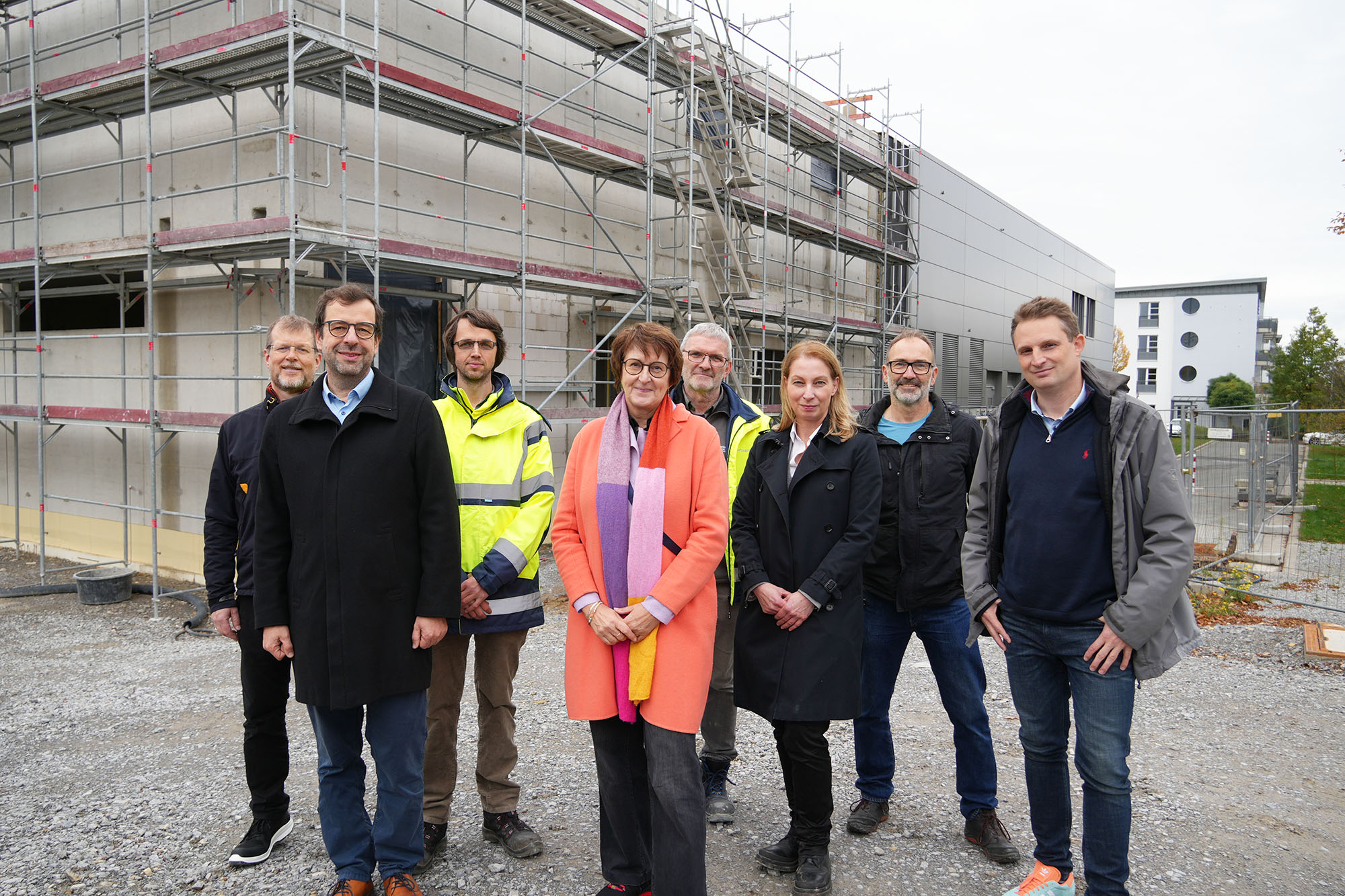
With the completion of the structural framework for the expansion of the datacenter in building X, a key milestone has been achieved on the path toward a powerful, future-proof, and sustainable IT infrastructure.
The expansion is necessary because the datacenter X is approaching its operational limits with the commissioning of the second high-performance computer, Otus.
However, the next phases of development will require an electrical connection capacity of up to 4.6 megawatts. Doubling both the electrical power and cooling supply is therefore essential.
Special emphasis continues to be placed on energy efficiency. The cooling of systems is realized throughout the year using approximately 95% indirect free cooling, significantly minimizing environmental impact.
Furthermore, waste heat is being supplied to nearby buildings for reuse, further enhancing overall energy efficiency.
The environmental friendliness of datacenter X will be further highlighted by the planned certification according to the "Blauer Engel" standard, to be obtained after completion of the technical installations.
This certification represents an important step in documenting the center's sustainability and environmental compatibility.
"We are proud that we have successfully implemented this important milestone within both the financial and time schedule, in close collaboration with the Bau- und Liegenschaftsbetrieb (BLB) Bielefeld," said Dr. Martina Gerdes-Kühn, Head of the Department for Building Affairs at the University of Paderborn.
"With this expansion, we are strengthening high-performance computing and making a future-oriented investment in the University of Paderborn," stated Prof. Dr. Christian Plessl, Director of the Paderborn Center for Parallel Computing (PC2), the institution that operates the HPC computing systems.
The PC2 is an integral part of the University of Paderborn’s digital infrastructure and serves as a shared resource for other universities in North Rhine-Westphalia.
It is also one of nine national centers for High-Performance Computing (NHR) in Germany.
Researchers find here a secure and powerful platform to meet their high-performance computing needs.
With the expansion to over 4 megawatts of electrical power and cooling capacity, the PC2 is better equipped than ever to meet the growing demands of researchers—particularly within the framework of the National High-Performance Computing (NHR) initiative.
The launch of the hpcFachCluster is planned for 2026, which will significantly strengthen HPC infrastructure for users across North Rhine-Westphalia.
Additionally, further expansion is already underway to meet rising demand for AI resources, reinforcing Paderborn’s position as a leading hub for cutting-edge scientific research.
More information
- https://pc2.uni-paderborn.de/system-access
- https://www.mkw.nrw/themen/wissenschaft/wissenschaftspolitik/hochleistungsrechnen-hpc-den-hochschulen
- https://hpc.dh.nrw/de/hpcfachcluster
- https://www.nhr-verein.de/