
Documentation and Support
We maintain extensive user and developer documentation on how to access and use our infrastructure and services. The documentation aims to cover the common needs of new and experienced users, such as:
- Accessing the HPC systems at PC2
- Submitting compute jobs to the workload manger
- Available software packages and development tools
- System architecture and specifications
- Data management and additional services
- Frequently Asked Questions
For individual questions that are not yet covered by the documentation, problem reports or any other issue that requires personal assistance we offer email support via a ticket system. Please follow our guide on how to write a support ticket. You can also login in to our User Portal to open a ticket.
In addition to general technical support our team of HPC and application domain expert is also able to provide advice with the effective use of scientific software, software compilation targeting our specific environment and beyond.
Open Consultation Hour
To discuss individual technical or scientific questions, a personal consultation is often more effective than email support. We therefore offer regular open consultation hours (every Thursday at 13:00 PM), where users have access to consultations without prior appointment, in which basic questions can be clarified directly and, if necessary, follow-up appointments can be arranged. Typical questions discussed in these consultation hours are
- Individual issues with system access and software installation
- Design of research group-specific workflows
- Mangement of research data (transfer, post-processing, archival)
In addition, we also collaborate with other national HPC centers in offering topic-specific consultation hours and webinars, for example on how to use our systems effectively for AI applications.

Scientific Consulting and Intensive Support
The scientific support staff at PC2 can support you for example with:
- compute time proposals
- organization of development workflows for your scientific code like version control, continuous testing/continuous benchmarking/continuous integration,...
- support with the organization of a developer community with, for example, regular developer meetings
- code porting, debugging, optimization,...
- algorithm design, development, implementation, and benchmarking
- performance modelling
- workflow organization and research data management
- organization of scientific events like conferences and workshops
- provide HPC resources and tailored software environments for scientific workshops
If we can support you, please let us know via mail, visit our consultation weekly hour, or let us knows during one or our courses, events, or conferences.
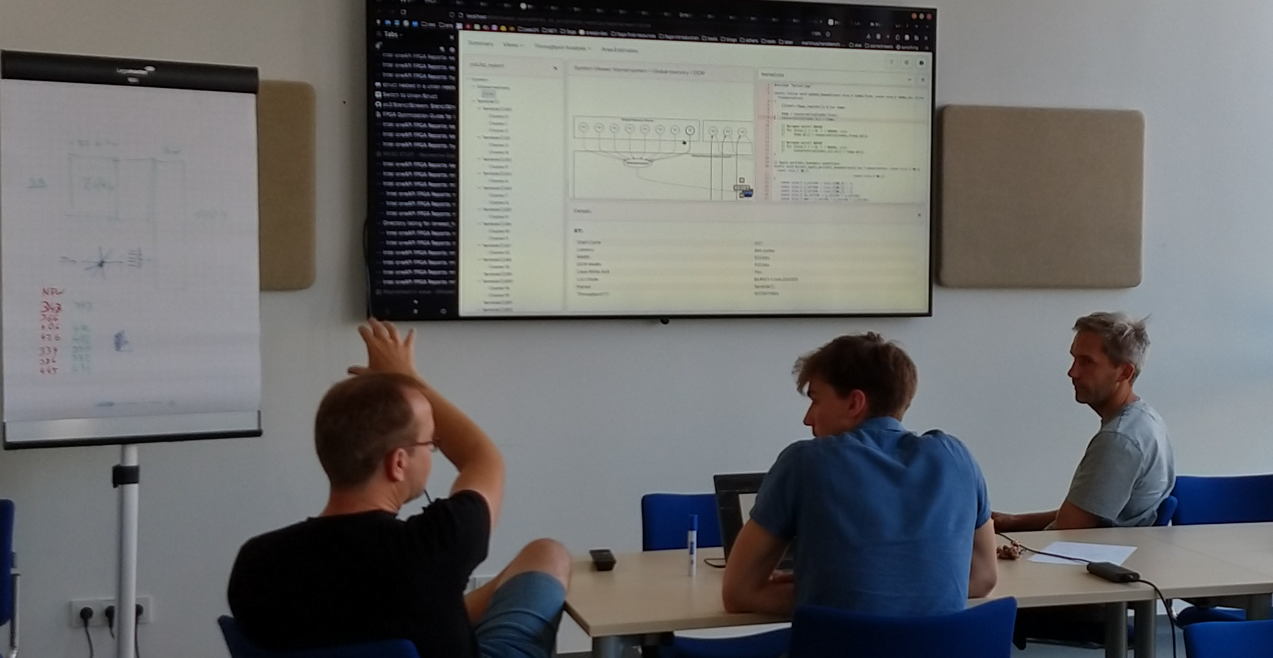
Selected projects that align with research focus of PC2, for example in atomistic simulations, computational physics and chemistry, or the use of FPGA and GPUs hardware accelerators, may also receive dedicated intensive support by the HPC and application experts of PC2. This type of support typically takes place within the framework of a longer collaboration, which, in addition to technical support, also includes scientific objectives and the joint further development of methods, simulation software or the development of services.
Example support projects
Some Examples from recent joint research within intensive support projects are:
- On-the-fly machine learned potentials for efficient ab-initio molecular dynamics (https://www.nhr-verein.de/en/AIC)
- PHOENIX: CPU/GPU-Solver for nonlinear two-dimensional Schrodinger equations of polariton condensates on CPUs and GPUs (paper, code)
- ExaXtb: Large-Scale parallelization and GPU-acceleration of linear-scaling density matrix tight-binding approaches with the submatrix framework (PoC code)
- Solving general minimizations problems with continuous-variable QAOA approaches on photonic quantum computers
- Quantum machine learning with photonic quantum computers
- Accelerating machine learning-based text classification for tax related research
- Development of scalable global and local submatrix methods for linear-scaling density functional theory
- Algorithm development for quantum chemistry on noisy intermediate-scale quantum computers (Paper)
- Accelerating the Compuation of Electron Repulsion Integrals with FPGAs (Paper)
- Developement of highly-scalable algorithms for quantum detector tomography (Paper)
- Characterizing Microheterogeneity in Liquid Mixtures via Local Density Fluctuations (Paper)
- Accelerating Shallow Water Simulations with CPUs, GPUs, and FPGAs (Paper, Paper, Paper)
- FPGA Acceleration for HPC Supercapacitor Simulations (Paper)
- Multi-GPU Lattice code for QCD calcualtions (Paper)
- Mutation Tree Reconstruction of Tumor Cells (Paper)